

A Paper Journal That Doesn't Lose Anything
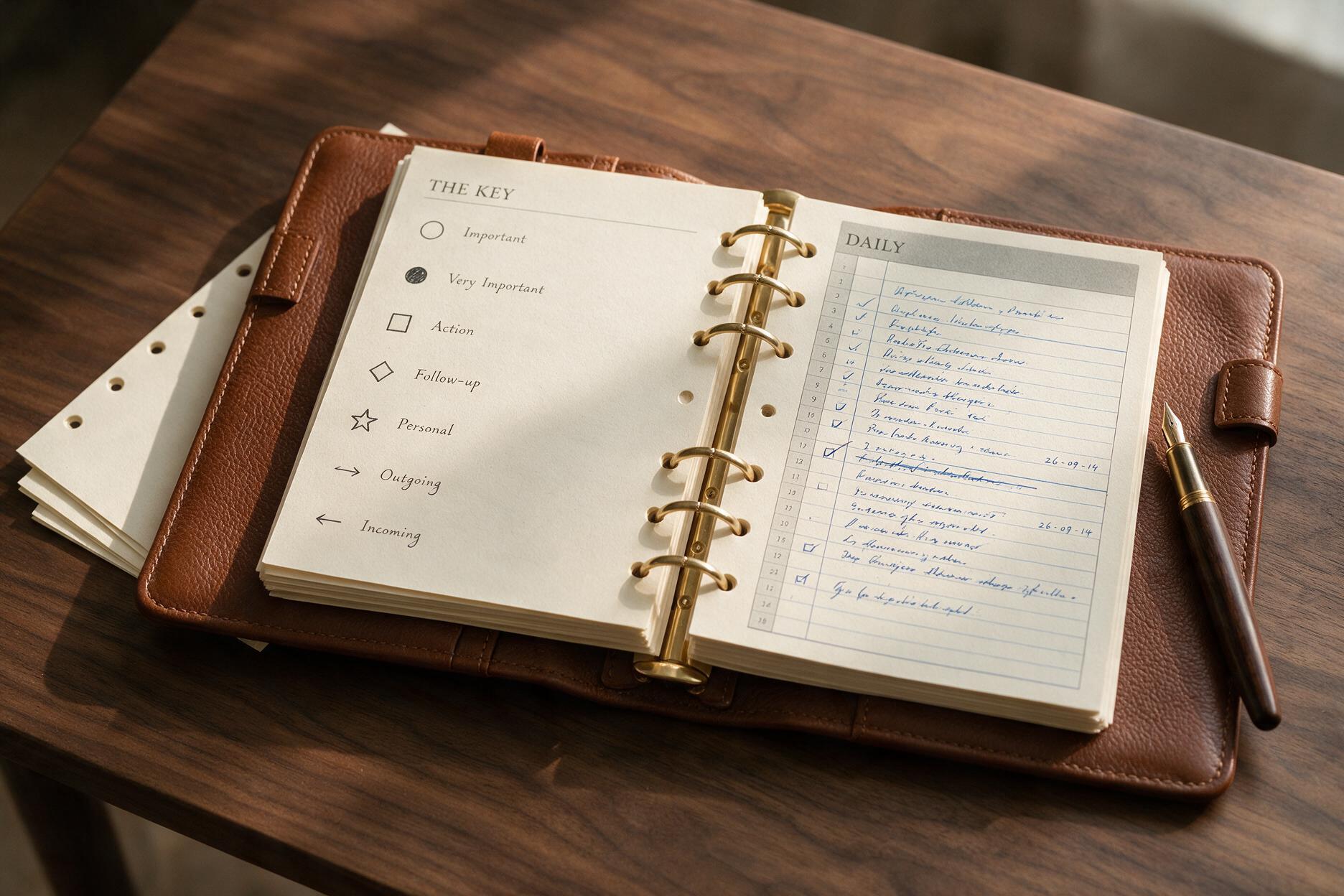
Why a filmmaker went back to paper, and the small mechanism that makes it work. The problem wasn't that I forgot things. It was that I couldn't find them.
Why a production team went back to paper, and the small mechanism that makes it work
The problem was never forgetting things. It was not being able to find them again.
Somewhere in a stack of notebooks is the sentence that became the opening of a film we're still cutting. We know it was written. We know roughly when. We've never found it. What we ended up with instead was a worse version, arrived at from scratch about four months later, because the original had disappeared into three hundred undated pages.
That's the failure mode nobody warns you about. Notebooks are excellent at capture and terrible at retrieval. Apps are the reverse — searchable, and somehow nobody opens them. We've tried both for years, and the honest result is a decade of thinking we can't get back to.
So we built something else. It's been running for a while now, it's made of paper, and the whole thing rests on one small idea.
Every entry gets an address
Before anything else, two characters go in the margin.
26-09-14.3
Year, month, day, and the third entry made that day. The date lives in the page header, so in practice you're writing .3 and nothing more. That's the entire overhead.
But once a thought has an address, something changes. It can be pointed at. It can be superseded. It can be grouped with thoughts from other months. A note without an address is a dead end — you can read it and that's all. A note with an address becomes part of a structure.
What it looks like in use
Monday afternoon, in the middle of something else, an idea lands:
.4 ○ open the doc with the shop, not the collector T-REW
The circle means idea, not yet good. T-REW is the thread it belongs to.
Friday, the better version arrives:
.2 ◉ open on hands. sleeve, needle, dust — no faces
for the first ninety seconds T-REW ← 26-09-02.4
The filled circle means refined. The arrow points back at Monday.
Then the part that actually matters. You turn back to Monday's page and add the forward arrow:
.4 ○ open with the shop, not the collector → 26-09-06.2
Two seconds with a pen. Now the chain reads in both directions, and the old idea points at its own replacement. Four months later, flipping past Monday, nobody spends twenty minutes reconsidering something already improved. Every link gets written twice — that's the one rule we'd keep if we had to throw everything else away.
Threads
Each living project gets a page, and that page is not for prose. It's a list of addresses:
T-REW — REWIND opened 26-08-11
26-08-11.7 ○ first structure sketch
26-09-02.4 ○ open with the shop → 26-09-06.2
26-09-06.2 ◉ open on hands ← 26-09-02.4
26-09-11.1 ◆ Yassine — 90 min, said yes
26-09-14.3 ○ cassette section handheld throughout
To read the project, you walk the IDs back to the days they came from.
This is the part we didn't expect to matter as much as it does. In November someone in a grade session asked why an entire section is handheld. Nobody in the room remembered deciding it. Three hops — index to thread to archive — and there it was, on the same page as two other entries: the day we confirmed we'd only have two shooters, and the day the drone permit question came up.
The handheld decision wasn't aesthetic. It came out of a crew-size constraint, and we'd collectively rewritten the memory as taste. A note in an app would have given us the decision. The journal gave us the day around it, which turned out to be the useful part.
The rest of it, briefly
There's a symbol set — a dozen marks for note, idea, action, in progress, done, event, question, milestone. Status symbols get overwritten rather than erased, so a task carries its own history: □ becomes ▣ becomes ■ on the page where it started.
There's an index: keyword to thread. It's the way in when you've forgotten the date, the project, and everything else. Retrieval is never more than three hops, and if a search takes longer, a keyword is missing — so you add it right then, while the answer is in front of you.
There's a radar page — the only one that looks past thirty days, read every Sunday. It's what catches the licence renewal six weeks out.
And goals are written as finished states rather than activities. "Work on the edit" can absorb infinite time and never complete. "22-minute cut, watchable end to end" is either true on the 30th or it isn't. Anyone can check it without asking.
The whole thing runs on four rituals: two minutes each morning, five each evening, twenty on Sunday, forty-five on the last day of the month. That's it.
The thing paper can't do
We want to be straight about the limit, because most people writing about analog systems aren't.
Paper cannot alarm you. Any system claiming otherwise fails the first time you're on a shoot at 6am. So the journal doesn't try to be the alarm. The rule we run is this: no timed event gets written in the journal until the alert exists on the phone. Same motion, both places. The phone is the trigger; the journal is the context — who, why, what was decided, what it connects to.
Underneath that sit three more nets, each catching at a different distance: tomorrow's commitments written twice before they arrive, the month calendar, and the radar for anything further out. A commitment has to escape all four to be missed.
One month at a time
Physically it's a small hand-sewn booklet, 105 × 190mm — thirty daily pages, a calendar, a radar, a goals page, thread pages, an index, and a few blanks. When the month is done, the whole booklet gets a label on the back cover and goes into the year archive intact. A fresh one starts.
We print them ourselves, four sheets at a time, on blank, ruled, graph and dot-grid stock. Everything in the layout sits on a 5mm grid, so on the graph and dot versions the form and the paper line up exactly rather than fighting each other.
Take it
The templates and the full manual are free to download. The manual walks through a complete worked month — an ordinary Monday, a Sunday review, the month close, and the November recall described above — plus the edge cases, which is where these systems usually break. What to do when a meeting moves. When a task belongs to someone else. When the day was chaos and nothing got written.
That last one has a rule worth underlining: if you miss a day, don't backfill and don't apologise on the page. Write today's date, carry forward what's still open, keep going. The system survives gaps easily. It doesn't survive guilt — which is what actually makes people abandon a journal in week three and start a clean one in January.
Run it exactly as written for a month before changing anything. Then change whatever didn't fit. The symbol key is a page, and it's yours to rewrite.
[Download the templates — blank, ruled, graph, dotted] [Download the full manual — PDF]